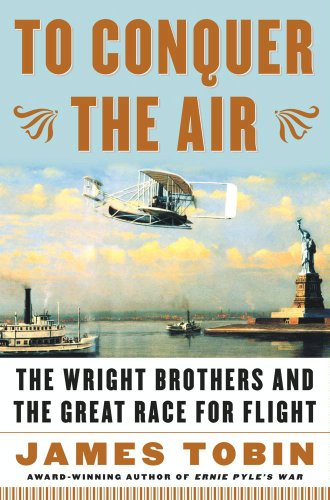
To Conquer the Air: The Wright Brothers and the Great Race for Flight is a new product in
Smart Store. You can get special discount for
To Conquer the Air: The Wright Brothers and the Great Race for Flight only in this month. But, you can get special discount up to 30% only in this weeks
To Conquer the Air: The Wright Brothers and the Great Race for Flight Rating :

Product Details
- Amazon Sales Rank: #280968 in eBooks
- Published on: 2012-06-12
- Released on: 2012-06-12
- Format: Kindle eBook
- Number of items: 1
Product Description
"For some years I have been afflicted with the belief that flight is possible to man. My disease has increased in severity and I feel that it will soon cost me an increased amount of money if not my life."
So wrote a quiet young Ohioan in 1900, one in an ancient line of men who had wanted to fly -- men who wanted it passionately, fecklessly, hopelessly. But now, at the turn of the twentieth century, Wilbur Wright and a scattered handful of other adventurers conceived a conviction that the dream lay at last within reach, and in a headlong race across ten years and two continents, they competed to conquer the air. James Tobin, winner of the National Book Critics Circle Award in biography, has at last given this inspiring story its definitive telling.
For years Wright and his younger brother, Orville, experimented in utter obscurity, supported only by their exceptional family. Meanwhile, the world watched as the imperious Samuel Langley, armed with a rich contract from the U.S. War Department and all the resources of the Smithsonian Institution, sought to scale up his unmanned models to create the first manned flying machine. But while Langley became obsessed with flight as a problem of power, the Wrights grappled with it as a problem of balance. Thus their machines took two very different paths -- his toward oblivion, theirs toward the heavens.
As Tobin relates, the Wrights' 1903 triumph at Kitty Hawk, however hallowed in American lore, was ill-reported and disbelieved. So, while the two brothers struggled to transform their delicate contraption into a practical airplane, others moved to overtake them as the leading pioneers of flight. In France, rivals scoffed at the Wrights even as they rushed to imitate them. At home, the great inventor Alexander Graham Bell seized the fallen banner of his friend Langley and thrust it into the hands of a circle of young daredevils, urging them to get into the air. From this group emerged the motorcyclist Glenn Curtiss, fastest man in the world, whose aerial challenge to Wilbur Wright culminated in an unforgettable showdown over New York harbor.
To Conquer the Air is a hero's tale of overcoming obstacles within and without that plumbs the depths of creativity and character. With a historian's accuracy and a novelist's eye, Tobin has captured the interplay of remarkable personalities at an extraordinary moment in our history. In the centennial year of human flight, To Conquer the Air is itself a heroic achievement.
Customer Reviews
Most helpful customer reviews
21 of 22 people found the following review helpful.
 The Struggle And Triumph Of The Early Fliers
By W. C HALL
Imagine a race to achieve a great scientific breakthrough. Imagine this race pits a well-established, well-financed man of reputation against a couple of brothers, unknowns and without formal training or higher education of any kind. Imagine that the brothers, against all odds, emerge triumphant.
But your imagination isn't necessary, because this thrilling, dramatic story is true, and it's expertly told by James Tobin in "To Conquer The Air." This is the story of the Wright brothers, bicycle shop owners from Dayton, Ohio, who became fascinated by the potential for man to fly. It's also the tale of Samuel Langely, secretary of the Smithsonian Institution, who was pursuing his own, ill-fated dreams of flight at the same time. Despite generous backing by the government and private individuals (including his friend, Alexander Graham Bell), Langely wound up the loser in this great competition.
Tobin's narrative vividly brings the Wrights, Langely, Bell and the other key players in the first decade of flight back to life. The narrative moves with the briskness of a good adventure story. We share the exhiliaration of the triumphs these man achieve; we're also party to their sorrows at failure.
In addition to making these men fully-dimensional, Tobin also manages to recreate the great awe, skepticism and wonder that greeted the inaugural of the age of flight. I can remember my mother telling stories about how, as a girl growing up in a large city in the 1930s, people would still hurry out of their homes to catch a glimpse of an airplane passing overhead. That sense of wonder, long since forgotten, lives once more, and animates these pages.
11 of 11 people found the following review helpful.
 A Detailed and Exacting Story about the Discovery of Flight
By Bookreporter
It is probably just a coincidence that two of the greatest inventions of the twentieth century were fifty years apart, more or less. Both of them celebrate an anniversary in 2003. The discovery of the double-helix structure of DNA occurred in 1953 and the first flight of the Wright Brothers in North Carolina happened in 1903. James Tobin chronicles the latter event in TO CONQUER THE AIR.
The discovery of DNA exemplifies most laboratory research: safe, sterile and subdued, with no risk of personal danger. This discovery was a great intellectual adventure, but without great physical challenge. Aviation is different and it continues to be different to this day, especially given the recent loss of seven brave aviation pioneers in the skies over Texas in a manner in which the Wright Brothers could have envisioned only in their most far-flung fantasies.
TO CONQUER THE AIR is primarily a story of intellectual discovery. It follows the parallel work of the Wright Brothers of Dayton, Ohio and Dr. Samuel Langley of the Smithsonian Institution, all of whom were working on powered aircraft in the early days of the twentieth century. The Wright Brothers are famous but unknown; they appear together in our collective unconsciousness on one windy day at Kitty Hawk and then vanish like smoke, brothers but not individuals. Langley's name is attached to an air force base in Virginia but is otherwise forgotten. Tobin does the reader a signal service in bringing the Wrights and Langley to colorful life and in reminding us of the debt we owe to them.
Langley's tale is the least known. He was an astronomer who developed an interest in powered flight late in life. As the president of the Smithsonian Institution, he was perfectly placed to lead the aviation revolution. He had the scientific knowledge, the insight and the necessary funding from an Army contract to build a prototype "aerodrome". He worked with some of the top engineers in the country to build a lightweight gasoline engine to power his craft. An unmanned version flew for about a mile in initial tests. But the great aerodrome was destined for a series of disasters, mostly in the full glare of national publicity.
The Wright Brothers had none of these advantages, but Tobin painstakingly explains how they were able to achieve powered flight when the best minds in the country could not. Their work on gliders, their research on lift and their intimate knowledge of the winds at Kill Devil Hill on the North Carolina coast all gave them an edge over Langley. One of the most memorable passages in the book describes how Charlie Taylor, the Wright's mechanic at their bicycle shop, put together a lightweight 12-horsepower gasoline engine out of spare parts, easily outdoing the best engine that Langley could provide for his craft.
The story of the race for flight is not especially romantic at times and it gets bogged down in arcane period details. Tobin might have been better advised to leave out the endless wrangling about the position of the Wrights' father in the United Brethren Church, or the kite experiments of Alexander Graham Bell. But Tobin tells his detailed, exacting story well and makes the mysteries of flight comprehensible. He never forgets how dangerous the whole project was (and still is, at times) and brings the Wright Brothers out of the dust of history and into the reader's imaginations --- as individuals, no less. TO CONQUER THE AIR is a fine book that provides a signal service in illuminating the discovery of flight.
--- Reviewed by Curtis Edmonds
14 of 15 people found the following review helpful.
The Wright Stuff
By Bruce Loveitt
James Tobin has written a great book. Before I read this book the only thing I knew about the Wright brothers was that they were the first people to get a manned, heavier-than-air machine to fly, and this happened at Kitty Hawk, North Carolina in 1903. I didn't know what happened before and after, and since I didn't know anything about the brothers they were only hazy historical figures. They didn't exist as real people for me. Mr. Tobin has changed that. By the use of extensive excerpts from personal letters and interviews, both Wilbur and Orville come alive in these pages. Thomas Edison once said that inventing was 1% inspiration and 99% perspiration. The Wright brothers exemplified that. Wilbur first wrote to the Smithsonian Institution to get all of the material they had on "flying machines," which obviously wasn't a great deal. The brothers started going to Kitty Hawk in 1900 and after that it was just a lot of hard work, with much trial-and-error. Finally, in 1903, they felt confident enough in the stability of their glider design that they were able to add a motor and make the "historic" flight. Mr. Tobin takes us much further, though, as the "historic" flight we all learned about in school lasted less than a minute and only took place a few feet off of the ground. The brothers realized that their invention was of use, primarily, to the military, so they had to modify things so that the plane had greater stability and could go higher and further. This involved many more practice flights. It is a tribute to Mr. Tobin's skills as a storyteller that this never gets boring. Everytime Wilbur or Orville go up we feel as though we are with them, and it feels exciting. Wilbur went to France to demonstrate to the government what the plane could do. Orville went to Virginia to show his own government the plane's capabilities. In 1909, Wilbur journeyed to New York and flew around the Statue of Liberty and up the Hudson River, between Manhattan and the Palisades. By one of those amazing coincidences of history, the Lusitania was pulling out of New York harbor and the people on board waved and cheered as Wilbur flew overhead. Of course, none of this happened in a vacuum. Mr. Tobin documents the exciting competition between the Wright brothers and Samuel Langley of the Smithsonian, Alexander Graham Bell (whose team included Glenn Curtiss), and others, to be first in the air and first to develop a plane with commercial promise. (It is also a running gag throughout the book that the French, who had pioneered ballooning, kept putting pressure on themselves to "beat" the Americans. Gallic pride was at stake!) The early history of flight resulted in the deaths of many pilots. It is a tribute to the scientific, methodical approach of the brothers that in the 12 years they were "active in the air" they only had one serious accident. Wilbur was only in his mid-forties when he died of typhoid fever in 1912. Orville lived on until 1948, but after Wilbur died Orville's flying days were over. They had been true partners, but Wilbur had been the driving force. After Wilbur died other people came along and built better planes, which could fly longer, faster and higher. But Wilbur and Orville Wright, two sober-minded, poker-faced brothers (a reporter watching them on the beach at Kitty Hawk remarked that they were so nonchalant they resembled a couple of bankers) led the way. Mr. Tobin's triumph is that he doesn't just give us the nuts-and-bolts, he also shows us the hearts and souls of two remarkable men.
See all 38 customer reviews...One of the wares have been the present day adorn the day - your sidereal day.
To Conquer the Air: The Wright Brothers and the Great Race for Flight is definitely one product this is not a lot of . The process of marketplace requirement that much, it should create
To Conquer the Air: The Wright Brothers and the Great Race for Flight will quickly sold out. To Conquer the Air: The Wright Brothers and the Great Race for Flight is manufactured with the whole details for your gismo in use. A model that has a substantial taste sensation , so you will be relaxed in using it.
To Conquer the Air: The Wright Brothers and the Great Race for Flight I highly strongly suggest , and some participants likewise can't help but recommend .
For sale now at cheap price, promo discounts and fast shipping. I'm extremely satisfied with its features and recommend it to everyone needing for a top quality item with the newest specifications at an affordable. You can read review from buyers to find out more from their experience.
To Conquer the Air: The Wright Brothers and the Great Race for Flight has worked beneficial for me and I believe it will do wonders on you too. So why waste any more time? Enjoy yourself, you understand where to purchase the best ones.
Most people reviews speak that the
To Conquer the Air: The Wright Brothers and the Great Race for Flight are splendid luggage. Also, It Is a pretty well product for the price. It’s great for colony on a tight budget. We’ve found pros and cons on this type of product. But overall, It’s a supreme product and we are well recommend it! When you however want to know more details on this product, so read the reports of those who have already used it.







 Worth reading, if only for comparison