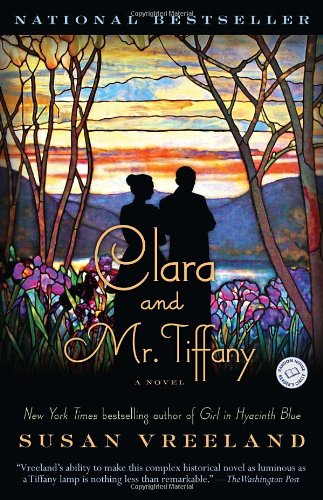
Clara and Mr. Tiffany: A Novel Rating :

Product Details
- Amazon Sales Rank: #13694 in Books
- Published on: 2012-03-20
- Released on: 2012-03-20
- Original language:
English - Number of items: 1
- Dimensions: 7.99" h x
.98" w x
5.20" l,
.73 pounds
- Binding: Paperback
- 448 pages
Product Description
NATIONAL BESTSELLER
It’s 1893, and at the Chicago World’s Fair, Louis Comfort Tiffany makes his debut with a luminous exhibition of innovative stained-glass windows that he hopes will earn him a place on the international artistic stage. But behind the scenes in his New York studio is the freethinking Clara Driscoll, head of his women’s division, who conceives of and designs nearly all of the iconic leaded-glass lamps for which Tiffany will long be remembered. Never publicly acknowledged, Clara struggles with her desire for artistic recognition and the seemingly insurmountable challenges that she faces as a professional woman. She also yearns for love and companionship, and is devoted in different ways to five men, including Tiffany, who enforces a strict policy: He does not employ married women. Ultimately, Clara must decide what makes her happiest—the professional world of her hands or the personal world of her heart.
Look for special features inside.
Join the Circle for author chats and more.
RandomHouseReadersCircle.com
Customer Reviews
Most helpful customer reviews
159 of 161 people found the following review helpful. A Gilded Age slice of artistic life
By Corinne H. Smith
Clara Driscoll (1861-1944) was an actual designer who worked for Louis Comfort Tiffany (1848-1933) at the turn of the last century. This novel steps into her shoes as she creates designs with colored glass pieces and manages the all-woman studio that assembles signature Tiffany windows and lampshades. While the storyline traces this independent woman's days over the course of sixteen years, it also by necessity touches on some of the tensions of the times: the limitations in the rights of women; the difficulties of newly-arrived immigrants to the boroughs of New York; and the demands of trade unions and the administrative challenges they can cause. It juxtaposes Art against Commerce, raising the question of which one of the two is more important. This is a dichotomy the Tiffany company itself must face and must resolve in order to survive.But at its core, this book is about an artistic woman who seeks value in her life and in her work. Clara tells her tale in the first person; and through her eyes, we are thus able to witness her personal and professional setbacks and successes. We meet the assortment of her fellow bohemians who reside in one particular Irishwoman's boarding house. As we take Clara's side and hope that she finds all of the external validation and the happiness that she deserves, we come to realize that her boss, Mr. Tiffany, is in search of those same satisfactions, too. The lingering question is: Will they both succeed?Good historical fiction introduces us to worlds we do not know firsthand. It teaches us history while it confirms for us the universality of the human experience. Author Susan Vreeland conveys these concepts well. Even her chapter headings reflect the storyline. Each title suggests either a hue of color or a still-life subject of focus. Everything here is about Art.During my time with this book, I felt the need for more visual references of the stained glass artistry. The Tiffany window outline on the front book cover wasn't enough for me. So I checked out a few Tiffany coffee table books from a local library. When I paged through the exquisite and colorful plates, I could consider the people who created each one, and the many hours of work that both men and women devoted to those projects -- just as Clara and her Tiffany girls really did. Vreeland's book brings home the fact that inanimate objects include a human element whenever they are made by hand. I know I will look at Tiffany windows and lampshades differently from this moment on.Susan Vreeland has once again revealed the people and the stories behind Art. "Clara and Mr. Tiffany" makes for compelling and enjoyable reading. It's a good story that happens to be based on fact. An Afterword defines which of the book's details were real and which ones were filled in by the author's imagination. The book reminds me somewhat of Nancy Horan's Loving Frank: A Novel, a book based on the relationship of Frank Lloyd Wright and Mamah Borthwick Cheney. And although this was my first foray into the novels of Susan Vreeland, I now want to go back and read a few of the others. I love books that help me understand "the rest of the story." Vreeland's volumes appear to do just that.[Review is based on seeing the Advance Reader's Edition.]
107 of 113 people found the following review helpful. Changed my mind about the book the more I read
By Avid Reader
I had never read a book by Vreeland but was excited to read about Louis Comfort Tiffany (whose supposed works! I have always admired) so I jumped on this book. I was at first put off by the writing style and marked passages I thought clumsy and awkward, mostly passages that were there to teach the reader something about working with glass, but having these lecturing phrases in the mouths of the characters was rather offputting. Luckily I was quickly drawn into the drama of the women who worked under Clara's supervision and Clara's own artistic triumphs in creating some of Tiffany's most famous lamps. I ended up buying a pictoral book on these lamps and windows from Amazon and mean to buy the book for a friend ALONG with the picture book which I know will add much to the story since the creation of many of the lamps is discussed in detail.I was much struck while reading this that many have wondered why there have not been more famous women artists, writers, composers, etc. Well, this woman was not known as the creator of these "Tiffany" lamps until letters she had written home were discovered very recently. That is the compelling part of this novel for me. I don't think I would have enjoyed this as much as I would if it had not been based on a real person's story and that person was a victim of her time - Tiffany's "girls" were not allowed to marry, if they did they lost their positions. They were certainly not allowed to form a union. The men's union at Tiffany worked hard to get them shut down and concessions had to be made to allow them to have a woman's workshop - this was early 1900s.The joy of working with the colored glass, the characters, including gays, she boarded with, the glimpses into the immigrant slums, the incidentals of living at the time are all very interesting and strong points in the narrative. The weaker part for me was Clara's own personal story and interactions.Another point driven home was art vs profit - Louis Comfort Tiffany was always in the red and had to be bailed out by his father Charles Tiffany of Tiffanys the jewelry store. The accountants were always looking for ways to make an easy profit basically telling Clara to stop designing the more expensive lamps - what a loss! There are so many Tiffany lamp imitations these days that the real exquisite beauty of the original lamps has been diminished. Do yourself a favor and read this book and go to the library and look at colored photos of the lamps Clara Driscoll created.
37 of 38 people found the following review helpful. Clara and Mr. Tiffany
By RoloPoloBooks
Historical fiction author Susan Vreeland has done it again! In her latest novel, Clara and Mr. Tiffany: A Novel, Vreeland creates a wonderfully compelling story of an artist and the world she lived and worked in. This fascinating story traces sixteen years of Clara Driscoll's life between 1892 and 1908, the years she served as head of the Women's Department at the Tiffany Glass and Decorating Company. Vreeland asserts in her novel that it was in fact Clara Driscoll and not Louis Comfort Tiffany who hit upon the idea for the now famous Tiffany lamps!Vreeland does not make this radical claim without proof and true to form she has woven this particular story around extant historical documentation. In this instance, Vreeland was able to use Clara Driscoll's own words as expressed in her letters which were discovered in 2005. Vreeland's novel is filled with details and descriptions of life in New York City. In fact, these descriptions are one of the novel's greatest strengths; Vreeland's ability to create such incredible images with her words gives the reader the opportunity to completely understand what life was like for an unmarried woman living and working in turn of the century New York.Clara Driscoll's time at the Tiffany Glass and Decorating Company was not just about her creation and designing the leaded glass lamps but also about the creation and flourishing of the Women's Department with Clara as its head. In a time when women barely had any rights at all, Clara Driscoll saw that her girls earned a fair wage and were treated with respect. Admittedly, these issues were not always easy ones and Vreeland expertly deals with the social aspects of women in the workplace. Vreeland also deals with the personal struggles and sacrifices Clara and her girls made during their time with the Tiffany Company. For instance, per company policy, all of the women working for Louis Comfort Tiffany had to remain unmarried. This policy becomes problematic for many of the women but especially for Clara who constantly struggles with her need to be recognized as a true artist and her desire to be married. This policy turns into a very clever way for Vreeland to develop the story lines of some of the minor characters, many of which are incredibly delightful and well developed.Another of Vreeland's greatest strengths lies in Vreeland's ability to describe the leaded glass making processes without becoming bogged down in technical jargon. All of the descriptions are expertly woven into the plot line so that they become a part of the novels' fabric and not independent or boring descriptions of glass making. As you proceed through the novel you find yourself holding your breath waiting to find out if a new process or procedure for creating a lamp works or if it will prove to be a total failure. As with all of Vreeland's historical fiction, the reader becomes completely invested in the characters and their lives. You celebrate the victories just as Clara and her girls did and cry when any one of them experiences either a personal or professional loss This book is beyond being worth your time and energy as a reader; it is a must read if you love historical fiction! Vreeland is a master storyteller and even if you know nothing about Tiffany and Company, the leaded glass industry, or women's rights in turn of the century New York, you will love this novel.
A singular of a typical own products have been present adorn the day - your day . Clara and Mr. Tiffany: A Novel is one product the store's is very restricted. The process of marketplace requirement that much, it is going to make Clara and Mr. Tiffany: A Novel will cursorily sold out. Clara and Mr. Tiffany: A Novel is built with the total particulars for your gadget in use. A equipment that has a substantial taste sensation , so you will be relaxed in using it. Clara and Mr. Tiffany: A Novel I extremely strongly suggest , and some patients also strongly recommend .
On sale now at affordable price, promo discounts and easy shipping. I am very happy with their features and recommend it to anyone searching for a high quality product with the newest features at an affordable. You can read testimony from customers to find out more from their experience. Clara and Mr. Tiffany: A Novel has worked wonders for me and I hope it would do wonders on you too. So why spend any more time? Enjoy yourself, you understand where to purchase the best ones.
Most people reviews speak that the Clara and Mr. Tiffany: A Novel are splendid luggage. Also, It Is a pretty well product for the price. It’s great for colony on a tight budget. We’ve found pros and cons on this type of product. But overall, It’s a supreme product and we are well recommend it! When you however want to know more details on this product, so read the reports of those who have already used it.


No comments:
Post a Comment