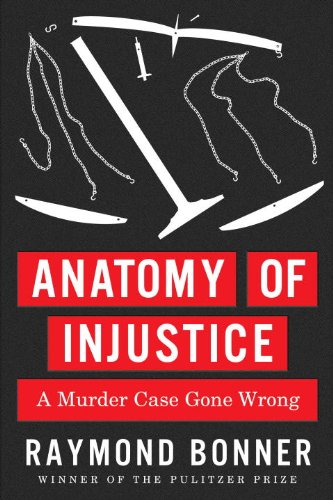
Anatomy of Injustice: A Murder Case Gone Wrong Rating :

Product Details
- Amazon Sales Rank: #92818 in eBooks
- Published on: 2012-02-21
- Released on: 2012-02-21
- Format: Kindle eBook
- Number of items: 1
Product Description
The book that helped free an innocent man who had spent twenty-seven years on death row. In January 1982, an elderly white widow was found brutally murdered in the small town of Greenwood, South Carolina. Police immediately arrested Edward Lee Elmore, a semiliterate, mentally retarded black man with no previous felony record. His only connection to the victim was having cleaned her gutters and windows, but barely ninety days after the victim’s body was found, he was tried, convicted, and sentenced to death. Elmore had been on death row for eleven years when a young attorney named Diana Holt first learned of his case. After attending the University of Texas School of Law, Holt was eager to help the disenfranchised and voiceless; she herself had been a childhood victim of abuse. It required little scrutiny for Holt to discern that Elmore’s case—plagued by incompetent court-appointed defense attorneys, a virulent prosecution, and both misplaced and contaminated evidence—reeked of injustice. It was the cause of a lifetime for the spirited, hardworking lawyer. Holt would spend more than a decade fighting on Elmore’s behalf. With the exemplary moral commitment and tenacious investigation that have distinguished his reporting career, Bonner follows Holt’s battle to save Elmore’s life and shows us how his case is a textbook example of what can go wrong in the American justice system. He reviews police work, evidence gathering, jury selection, work of court-appointed lawyers, latitude of judges, iniquities in the law, prison informants, and the appeals process. Throughout, the actions and motivations of both unlikely heroes and shameful villains in our justice system are vividly revealed. Moving, suspenseful, and enlightening, Anatomy of Injustice is a vital contribution to our nation’s ongoing, increasingly important debate about inequality and the death penalty.From the Hardcover edition.
Customer Reviews
Most helpful customer reviews
26 of 26 people found the following review helpful. Adversarial Justice System - an oxymoron?
By Durwood Gafford
Do not read this book unless you are prepared to have your views on the death penalty and our American justice system challenged. This is a powerful story of a South Carolina murder trial where planted evidence and perjury were used to convict and sentence to death a mentally retarded African American man; it's the story of inept defense lawyers and a politically driven "justice" system which rewards winning over fairness and truth - even when a man's life is at stake. This journey through our court system is engaging, thought-provoking, and often disturbing.When I started reading this book, I did so because of a general interest in true crime and our court system. At page one, my belief was that while the death penalty is often applied unjustly and capriciously in some states, it is appropriate for our more heinous criminals. As the author states, there are certain "horrific crimes" which "swell the ranks of capital punishment advocates and makes it hard for death penalty agnostics not to become believers." I didn't expect to be swayed from this belief. I was wrong.In particular, I was shocked to learn how difficult it is to be granted a re-trial after one is convicted, fairly or not, of a crime - even if that conviction results in a death sentence. As the author bluntly states, "Innocence alone does not entitle a defendant to a new trial." He quotes Herrera v. Collins: "Due process does not require that every conceivable step be taken, at whatever cost, to eliminate the possibility of convicting an innocent person. To conclude otherwise would all but paralyze our system for enforcement of the criminal law." The author summarizes this by saying, "the need for finality in legal proceedings sometimes trumps what might be seen as fundamental fairness." The Supreme Court further states that once a defendant has had a fair trial, "the presumption of innocence disappears." In descent, Justice Blackmun stated, "I believe it contrary to any standard of decency to execute someone who is actually innocent. The execution of a person who can show that he is innocent comes perilously close to simple murder." It's too bad that his was a minority opinion."Anatomy of Injustice" is as captivating as any thriller; the characters in this tale are intriguing and the plot chillingly unbelievable for a work of non-fiction."If there is a flaw in the adversarial system of justice that has developed in America, it is that the adversarial nature of it outweighs justice."Highly recommended.
2 of 2 people found the following review helpful.Outstanding Book on Some Chilling Events
By Mark Wylie
When I was much younger, in what I refer to as the "College Republican" phase of my life, I supported the death penalty. It has been nearly 20 years since I ceased to do so; when I switched sides on this issue, I did so because I came to understand the flaws in our criminal justice system, and in particular in the administration of the death penalty--flaws which I have concluded are irreparable. This excellent book identifies many of those flaws, and I commend it to any reader interested in our criminal justice system and in trying to make it function in a way that is truly just.The injustice which the title of this book refers to was inflicted on Edward Lee Elmore. In 1982, Elmore, a then 23-year-old African American from Greenwood, South Carolina, was arrested for the murder of an elderly white woman, Dorothy Edwards, for whom he had recently done some home maintenance work. He was convicted of her murder and sentenced to the death penalty. Elmore then spent roughly 30 years in prison, almost all of on death row. While neither I nor any reader can conclude with 100% certainty that he was not guilty, it is hard to avoid the conclusion, after reading Raymond Bonner's book, that Elmore was most likely innocent of the crime for which he spent years in prison and nearly was executed for, and that someone else murdered Dorothy Edwards and got away with it. It is my opinion that this is what happened.Raymond Bonner is an experienced journalist and a very good writer, the author of excellent books on many subjects. He is also a former lawyer and law professor. As such, he is well equipped to write a book like this. He skillfully guides the reader through both the factual record and the potentially confusing legal issues. Thanks to his excellence as a writer, we come with a real feel for the flesh-and-blood people involved in this case, especially Elmore and his most tenacious defender, attorney Diana Holt. As I noted above, Bonner highlights several flaws in the criminal justice system, flaws which I believe make our current death penalty hopelessly unjust, and which I think are grounds for permanently abolishing the death penalty.First, it is possible to be convicted of a serious crime, even a capital crime, based on very sketchy evidence. The key evidence presented against Elmore can be summed up as follows: 1) a single thumbprint identified as his was found on the outside of Edwards' house, which was reasonably the result of the maintenance work he had previously done; 2) the clothes he was wearing were found to have a few tiny specks of Type A blood, a blood type Edwards shared with about 40% of the population, and which was not Elmore's blood type; 3) the local medical examiner gave the opinion that the time of death was on a Saturday night during a period when Elmore had no alibi; 4) a police forensic expert testified that a number of hairs entered into evidence were, first, pubic hairs found on Edwards' bed, and second, that these hairs were probably, but not certainly, Elmore's; 5) a jail inmate who had been in jail with Elmore got on the witness stand and asserted that Elmore had confessed the murder to him.As a corollary to this, it's important to note evidence that was not presented at Elmore's trial: 1) fingerprints were found inside Edwards' house which were not Elmore's or the victim's, but a third party's; 2) Pubic hairs recovered from Edwards' body (not her bed) were established definitively to be Caucasian (meaning they weren't Elmore's), and not from Edwards herself. This evidence was not presented at the trial because the police and prosecutors, in violation of well-established, unambiguous law, did not turn it over to the defense attorneys.This leads into the second major flaw in the system, the inadequacy of the representation received by many criminal defendants. While it's conceivable that if the jury hearing Elmore's case had included a few tough-minded skeptics, they might have identified the weaknesses in the prosecution case without any guidance, our legal system puts the primary responsibility for doing so on defense attorneys. Certainly, a competent defense attorney could have torn many holes in the prosecution case. For instance, a competent attorney, even working against the handicap of not seeing the illegally suppressed evidence I just mentioned, could have pointed out the implausibilities in the prosecution's scenario for the crime: Why did Elmore have only tiny specks of blood on his clothes, when the victim bled profusely? Why was there no blood at all on his white shirt, especially if he carried her to the closet where her body was found? Why, if the crime took place on Edwards' bed, was none of her blood found there? Why were no photographs taken of the pubic hairs supposedly found on the bed, contrary to fundamental rules of crime scene examination? Likewise, a competent defense attorney could have had an independent expert examine the pathological evidence, and point out that the main evidence, namely the state of Edwards' body, pointed strongly towards a time of death on Sunday afternoon (when Elmore had a strong alibi). It could then have further been pointed out that the medical examiner's contrary opinion about the time of death was based largely on trivia, such as the fact that the victim's TV Guide was open to the Saturday night listings (all of this was established later, during one of Elmore`s appeal proceedings). Finally a good defense attorney could have discredited the testimony of the snitch, possibly even gotten him to admit, as he in fact did admit years later, that his testimony was made up.Unfortunately, Elmore did not have competent representation during his trials. His primary attorney was the local public defender, Geddes Anderson. Anderson was an alcoholic, and was reported by at least one prosecution witness, a state police detective, to have been drunk in court every single day of the trial. Anderson was assisted by a mediocre local attorney, John Beasley, who refereed to his client as "a redheaded n---er." Certainly, in a fair system of justice, Anderson's alcoholism in and of itself would be sufficient to establish that Elmore did not have adequate representation. Leaving aside Anderson's drunkenness and Beasley's borderline racism, their performance in the trial was terrible. They raised none of the issues I note above. Their cross-examination of virtually every prosecution witness was perfunctory. It is no surprise that he was found guilty in two criminal trials (the verdict from the first trial was overturned owing to conduct by the judge that was so unfair and discriminatory that it could not be ignored. Amazingly, this judge, one E. C. Burnett, went on to be appointed to the South Carolina Supreme Court).This problem of ineffective representation is endemic throughout the criminal justice system, and is a particular taint on the administration of the death penalty. Stephen Bright, one of the most experienced attorneys in the country in dealing with death penalty cases, has researched this issue. His conclusion is that what happens in practice is that people are sentenced to death "not for the worst crime, but for the worst lawyer." If we are to retain capital punishment, than one mandatory element for it to be a just punishment is that it must be reserved for the worst offenders. This is clearly not the case.This leads into the third major flaw which Bonner brings out. Once someone has been found guilty in a trial court, then no matter how weak the case against them, no matter what exculpatory evidence comes to light after the trial, no matter how procedurally flawed the trial was, it is very, very hard to get the verdict of the trial court overturned. Appellate courts use a standard of what is called "deference to the trial court" when it comes to factual findings. This means that the appellate judge or judges generally will not review the facts of a case and make their own judgment about the innocence or guilt of the defendant; rather, they will accept the findings of fact by the trial judge and/or jury, even if they find them questionable.To a certain extent, such an approach is defensible. The problem that the Elmore case shows is that appellate courts have gone much, much too far in their deference to trial courts. If all Elmore had done in his appeals was to effectively say "Hey, how about if you judges take a second look at the same exact facts that the jury in my trial heard, and let me go if you don't agree with them," then assuming no other procedural errors in the trial (a big assumption, as I`ll discuss in a moment), the appellate court would be justified in its deference. However, Elmore did far more than that. In his appeals, he demonstrated that 1) much of the evidence against him in the trial was flawed--the snitch was perjuring himself by his own admission, the medical examiner's estimated time of death was not justifiable based on the physical evidence, etc., and that 2) there were significant pieces of exculpatory evidence which were kept out of his trial because the police and prosecution hid them from his defense attorneys. To my mind, either of these demonstrations should have been sufficient to warrant ordering a new trial for Elmore; both of them together should definitely have gotten him a new trial.The other issue with appellate courts that Elmore's case highlights is the extreme difficulty of getting a verdict overturned when a defendant's attorneys do not do their jobs properly. The deference that appellate courts generally show to the trial courts' factual conclusions is only justified on the assumption that every defendant is getting a competent, vigorous defense. I'm sure that most of us would agree that if your attorney is drunk in court every day, as Geddes Anderson was, they are clearly not capable of representing you effectively--we'd expect that any case where that happened would automatically result in a new trial. The reality is very different. A few minutes of googling led me to numerous cases from different parts of the US where appellate courts denied a new trial even when they acknowledged that it was demonstrated that the defense attorney was "drunk on duty," as it were (in one case, the attorney had actually been arrested for drunk driving in the middle of the trial). Likewise, I found cases where appellate courts ruled that the following circumstances did not constitute ineffective representation: attorneys in multiple cases who slept through significant portions of the trial, an attorney who was going senile and was suffering from severe physical maladies, and an attorney who was insane and openly discussed his paranoid delusions in court. Leaving aside whether the defendants in these cases were actually guilty or not, the fact is that we as citizens need to be able to have confidence in our court system, and when people are represented by attorneys who are drunk, insane, senile or merely sleeping, it is completely impossible for any reasonable person to have that confidence.But the problem of ineffective counsel is even worse. It's not just that drunken or senile attorneys are representing people. The key Supreme Court case on this issue, Strickland v. Washington, opens a whole additional can of worms. Strickland requires that an appellate court find, before giving a defendant a new trial, not only that their attorney was seriously ineffective, but that there is a substantial probability that the ineffective assistance had an effect on the verdict. This allows appellate courts an immense amount of wiggle room to ignore ineffective representation, by declaring that "it wouldn't have affected the verdict." Justice Thurgood Marshall, dissenting in the case, pointed out the problem with this standard--the justness of the court system depends not only on reaching the right outcomes, but on reaching them through recognizably fair procedures. I agree with Marshall--the ability of ordinary citizens to have confidence in our judicial system rests on our perception that we, along with our family, friends, co-workers, etc., will get a fair deal if ever we find ourselves in court.One issue that Bonner does not spend a large amount of time is solutions. Abolishing capital punishment would clearly make our system of justice more fair, by eliminating the potential for the ultimate injustice--the execution of someone who is innocent. But that by itself would not solve the problems Bonner identifies. A few further steps come to my mind:1) We need to implement strong measures to prevent police and prosecutors from keeping exculpatory evidence from defense attorneys. Elmore's case is not an isolated one; evidence is withheld, hidden, destroyed, etc., all over the country. Nate Blakeslee's book Tulia: Race, Cocaine, and Corruption in a Small Texas Town is an excellent account of how dozens of criminal convictions were obtained, in part because the local prosecutor withheld significant evidence on a systematic basis. I think any prosecutor who actively participates in withholding evidence should be disbarred (as happened to Mike Nifong of Duke lacrosse case infamy). Police officers who actively participate in withholding evidence should be fired and barred for life from working in law enforcement. Needless to say, if police or prosecutors go beyond withholding evidence and actually fabricate evidence (as also happened in Tulia), even stronger steps, including criminal charges, should be taken.2) The justice system as a whole needs to seriously scale back its reliance on the testimony of jailhouse informants, aka "snitches." Several studies have shown that testimony by lying snitches is one of the leading causes of wrongful convictions in capital cases in the US. Alexandra Natapoff's excellent book Snitching: Criminal Informants and the Erosion of American Justice describes a lengthy catalogue of problems with the use of informants in law enforcement and the criminal justice system. In the long run, police and prosecutors will have to stop relying so much on unreliable informants, but in the shorter term, judges and juries can nudge them in the right direction by treating the claims of snitches with extreme skepticism.3) Most important, we need to ensure that anyone charged with a serious crime, whether it carries a potential death sentence or not, receives competent, effective legal representation throughout the process. I mentioned the Duke lacrosse case above, in which a politically ambitious prosecutor pursued false charges of rape against three Duke students, and persisted in pursuing the case far, far beyond the point where there was any reasonable basis for thinking the students guilty of a crime. If these three young men had not received high-quality legal representation from the moment they were snared by the tentacles of the justice system, they might have gone the way of Edward Lee Elmore or the Tulia defendants, and been convicted of crimes they did not commit. Every defendant should be represented as ably. As I said above, without that, we can't have confidence that our judicial system is fair.One way to nudge state and local authorities into ensuring that this is the case is for appellate courts to be much more vigorous in upholding the rights of defendants to effective representation. Needless to say, if an attorney is found to be drunken, mentally ill, etc. during a trial, that should be automatic grounds for giving a defendant a new trial. Also, Strickland v. Washington should be overruled, either by the Supreme Court reversing itself or by statute. Until that happens, appellate courts should be much more ready to conclude that ineffective representation has prejudiced the verdict in a case, using the wiggle room in the Strickland decision to produce more justice, not less.4) Finally, all of us, as voters, can do our part. We need to stop being seduced by "tough on crime" rhetoric from politicians, and start paying attention to those elected officials, all too few these days, who respect the right of everyone to due process of law. When politicians promise to "reform" things to make it easier to execute people, we need to vote them out of office, not into office. When candidates go ballistic about "judicial activism" after a court protects the rights of a defendant, we need to vote against them, not for them.I've wandered away from directly discussing Bonner's book for a bit, so let me close by returning to it. Bonner ends his narrative in late 2011, when a panel from the Fourth Circuit Court of Appeals, probably the most conservative of the federal circuit courts, ruled by a 2-1 majority that Elmore was entitled to a new trial. The majority opinion meticulously catalogues the innumerable injustices which have been inflicted on Elmore; the dissent by Judge J. Harvie Wilkinson is very brief, and I do not find it at all convincing. After Bonner's book went to press, the final resolution of the case took place. South Carolina officials had talked of appealing the case to the US Supreme Court, rather than either giving Elmore the new trial ordered by the 4th Circuit, or acknowledging the injustice they had done him by dropping the charges and freeing him (which in my opinion is what they should have done). In the end, they took a rather craven third option. They offered Elmore the chance to enter a so-called "Alford Plea." An Alford Plea, as I understand it, involves the defendant making a technical plea of guilty while still maintaining his or her innocence. In return for making this plea, the state agreed to a sentence equal to the time Elmore had already served (roughly 30 years). As a result, Elmore was set free after 30 years in prison for a crime that he almost certainly did not commit.Meanwhile, not one of the many South Carolina officials who played a part--whether through malice, indifference to justice, incompetence, or any other cause--in this travesty of justice has paid any sort of price. With one or two partial exceptions--I think primarily of one state judge who overturned Elmore's death sentence, although not his conviction, because Elmore was found to be mentally retarded--none of the South Carolina officials involved in this case can take any pride in their actions, and many of them should be forever ashamed of their conduct.Edward Lee Elmore is now free, but it can't be said that he received justice. The system failed him, over and over. At the same time, the system also failed Dorothy Edwards, and her family and others who loved her. For it is extremely likely that someone murdered her and got away with it.
2 of 2 people found the following review helpful.Compelling, Important, and Disturbing
By Book Fanatic
This is an incredibly powerful book. The title nails the subject matter exactly. Raymond Bonner examines very closely the case of Edward Lee Elmore from beginning to end (almost as there is a final update this spring). This case has about everything that could possibly be wrong with American justice and almost nothing that is right. It's a distressing read. While I think what happened to this defendant is fairly rare percentage wise, there is NO excuse for it ever happening here. It's almost believable that it happened once but during almost 30 years of travels through the court system that it took someone this long to do the right thing is inexplicable.I know that the author and the defense lawyers believe Edward Lee Elmore is innocent. Whether he is or not I don't know despite a very powerful argument that he is indeed innocent in fact. However, what should be clear to any reasonable person is that he was abused and abused badly by the criminal justice system and that the rest of us should be outraged and those involved should be ashamed. Justice was not done in this case regardless of the guilt or innocence of the defendant.I very highly recommend this book to any American of any law and order persuasion. It's that good and what's more it's that important.
A singular of a typical wares have been todays adorn the sidereal day - your day . Anatomy of Injustice: A Murder Case Gone Wrong is definitely one merchandise your is restricted . The process of marketplace requirement that much, it can make Anatomy of Injustice: A Murder Case Gone Wrong will quickly sold out. Anatomy of Injustice: A Murder Case Gone Wrong is made with the entire particulars for your contraption in use. A device that has a lofty taste sensation , so you will be comfy in using it. Anatomy of Injustice: A Murder Case Gone Wrong I extremely can't help but recommend , and some avid gamers as well strongly suggest .
For sale now at cheap price, promo discounts and easy shipping. I am very satisfied with their features and recommend it to everyone hunting for a good product with the newest features at an reasonable. You can read testimony from buyers to find out more through their experience. Anatomy of Injustice: A Murder Case Gone Wrong has worked wonders for me and I hope it would do wonders on you too. So why spend any more time? Enjoy yourself, you understand where you can purchase the best ones.
Most people reviews speak that the Anatomy of Injustice: A Murder Case Gone Wrong are splendid luggage. Also, It Is a pretty well product for the price. It’s great for colony on a tight budget. We’ve found pros and cons on this type of product. But overall, It’s a supreme product and we are well recommend it! When you however want to know more details on this product, so read the reports of those who have already used it.


No comments:
Post a Comment